

What is IPTedia?
IPTedia, offers a wealth of resources for those interested in delving into the intricacies of IPT. It provides tutorials, articles, and interactive content focused on JavaScript and HTML, which are foundational technologies for web development.
Integrative Programming and Technologies (IPT) is a fascinating field that merges various programming disciplines and technologies to create cohesive and efficient systems.
JavaScript
known for its versatility and ubiquity across web browsers, allows developers to create dynamic and interactive user experiences.
HTML
on the other hand, is the standard markup language used to structure content on the web.
How does IPTedia help you as a programmer?
By mastering these languages JavaScript and HTML, individuals can lay a solid foundation for their programming skills. IPTedia likely covers a range of topics from basic syntax to advanced concepts, enabling users to progress at their own pace. Whether you're a beginner looking to understand the basics or an experienced programmer aiming to refine your skills, IPTedia seems to be a valuable resource. The platform may also delve into how IPT can facilitate the integration of different technologies, making it possible for systems to communicate and operate harmoniously.
Aspects of IPT
The Aspects of IPT
is crucial in today's interconnected digital landscape, where seamless data exchange and system interoperability are essential. Moreover, IPT involves a strategic approach to problem-solving, where the focus is on creating solutions that are not only effective but also sustainable and adaptable to future technological advancements
In essence, IPTedia appears to be a comprehensive guide for anyone eager to explore the realm of Integrative Programming and Technologies, offering insights into how to harness the power of JavaScript and HTML to build robust, scalable, and integrated web applications.
Advantages of learning IPT
These are the Advantages of Learning IPT
- Enchanced Interoperability: Integrative programming facilitates communication between different software systems, allowing them to work together seamlessly.
- Flexibility in Development: It allows the use of the best-suited programming languages or technologies for different components of a system.
- Efficient Data Exchange: Promotes efficient data sharing and processing across various platforms and technologies.
- Support for Evolving Business Requirements: Helps organizations adapt their IT infrastructure to support current and future business needs.
- Global Collaboration: Enables secure collaboration within an organization and with external business partners on a global scale.
Example of a JavaScript code
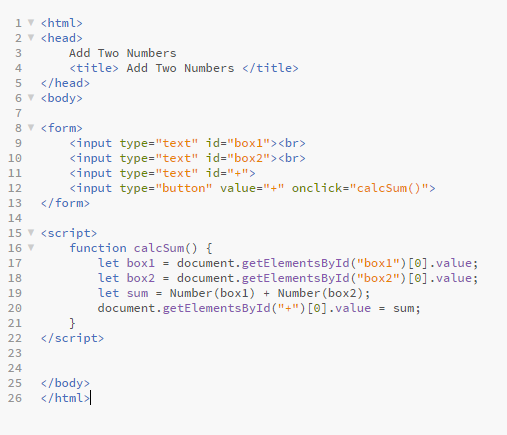
Contents of the code
-
HTML Structure:
'html' defines the start of the HTML document.
'head' contains information about the HTML documnet.
'title' sets the title of the HTML document.
'body' contains the visible content of the HTML document. -
Form:
'form' defines a form to collect users input.
'input type="text" id="box1"' text input field for the first number.
'input type="text" id="box2"' text input field for the second number.
'input type="button" value="+" onclick="calcSum()"' button triggering the addition calculation.
'input type="text" id="result"' text input field to display the result.
-
JavaScript:
'script' defines client-side JavaScript code.
'function calcSum() { ... }' defines the function to calculate the sum of the two numbers.
'let box1 = document.getElementById("box1").value' retrieves the value entered in the first input field.
'let box1 = document.getElementById("box2").value' retrieves the value entered in the second input field.
'let sum = Number(box1) + Number(box2);' calculates the sum of the two numbers.
'document.getElementById("result").value = sum' sets the value of the result input field to the calculated sum.